Investment Decisions When Forecasts Differ: 1.7% vs 3.1%
Published 9 October 2026 · Last updated 12 October 2026

When forecasts differ, an investor does not pick one forecast; the decision is tested in more than one scenario. A live example is in front of us: the International Monetary Fund expects the Saudi economy to grow 1.7% in real terms in 2026 (its July 2026 assessment), while the World Bank expects 3.1% for the same year (its June 2026 report). The gap is 1.4 percentage points between two credible institutions, in a year framed by a war in the region. This article shows how a decision can be built on that gap instead of being stalled by it.
What is the difference between the two forecasts?
- IMF (Article IV consultation, July 2026): real growth of 1.7% in 2026 after 4.6% in 2025, then 5.5% in 2027. It expects foreign direct investment to fall from 2.6% of GDP in 2025 to 1.5% in 2026 and 2027.
- World Bank (June 2026): growth of 3.1% in 2026, 4.9% in 2027 and 3.7% in 2028, and it judges that the weakening of growth in Saudi Arabia will be less pronounced than the sharp slowdowns it projects for Iraq, Kuwait and Qatar, mainly because of the ability to reroute oil exports through the East-West pipeline.
The two documents do not explain the difference. The IMF ties recovery to shipping through the Strait of Hormuz normalising over the coming months, so we see differing assumptions about how long the disruption lasts as a possible reason; that is our view, not wording in either document.
How does an investor decide with this disagreement?
- Define the decision first: is it a new entry, an expansion or a deferral? Each is sensitive to growth in a different way.
- Test it in at least two scenarios: a base case and a conservative one, not the optimistic one alone. If the decision still works in the conservative case it is stronger; if it does not, the investor needs a fallback plan.
- Tie it to indicators to watch, instead of waiting for one forecast to win. Quarterly flow data is among them.
- Set a specific review point, such as the release of the next quarter's data, so that waiting does not turn into an open-ended deferral.
In Zeej's calculations of foreign investment flows over 2021–2030, the three scenarios range between 51% and 83% of the National Investment Strategy target (sensitivity exercises, not forecasts), and none reaches the target. It is an example of a result that changes with assumptions, not with facts.
Which indicators should be watched now?
According to the General Authority for Statistics, net foreign direct investment flows were SAR 22.7 billion in the first quarter of 2026 (as updated) and SAR 19.1 billion in the second quarter (preliminary data), SAR 41.8 billion in the first half. If the IMF's ratio (1.5% of GDP) is applied to estimated 2026 nominal GDP (about SAR 5,244 billion on the IMF's own estimate), the full-year equivalent is about SAR 78.7 billion, so the first half is about 53% of it (Zeej calculation). The first half cannot be doubled into an annual estimate, since the fourth quarter of 2025 alone reached SAR 48.0 billion (as revised). Applying the IMF ratio to GASTAT net flows is an approximation, not a match between two definitions.
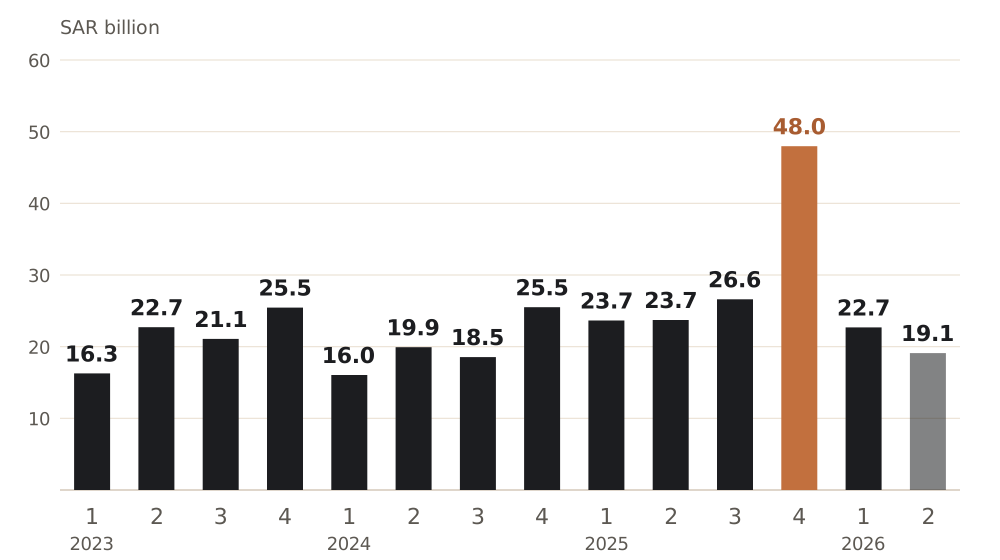
The IMF warns that a prolonged conflict could weigh on investor sentiment and on foreign direct investment, but notes that foreign investments are mostly long-term and strategic.
When is the next review point?
The General Authority for Statistics releases its quarterly foreign investment bulletins some months after the quarter ends, and the second-quarter 2026 bulletin was out before 5 October 2026. We know of no announced date for the third-quarter bulletin and, in our reading, expect it around the end of December 2026 or later and would be a suitable review point for the decision.
What are the limits of this article?
- Forecasts are revised between reports; the figures here are the latest we opened from the two institutions at the time of writing.
- The article does not forecast growth and does not recommend a specific investment decision.
- Zeej's calculations in this article are labelled, and their assumptions are in the methodology annex of our full study, "How to Invest in Saudi Arabia: New Law and Capital Flows".
Zeej works with investors on testing a decision across scenarios, within our «Investment Opportunity Assessment» service.
Want to see where your business stands?
Start with our free diagnostic and get a first, structured reading of your business.
Start the Free Diagnostic